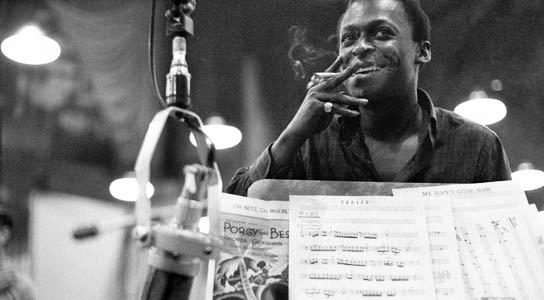
“The hero ends so much more than it lasts a bore,”John Szwed, a professor of music and jazz studies at Columbia University while giving a lecture, “Miles Davis: The Jazz Musician as Dandy” at DePaul University on Oct. 17. He continued, “And nothing is more boring than a hero left over from an era that people want to forget.”
Twenty years after Miles Davis’ death and the world still turns. Iconic beauties are still bountiful, but few master the art form of becoming a legacy.
“This was a challenge that Miles would confront by changing his music and his clothes again and again,” Szwed said. Davis dressed both up and down, Szwed said, “and he would do this back and forth so at one point you would wear what looks like hip-hop clothes and the next time you see him he is wearing the most extreme Japanese fashion.”
To Davis, style was part of his art. It was just as much of an expression going into his music as it was coming out.
“Never for a second did [Davis] allow anyone to believe that he was just there to entertain,” Szwed said. “On one occasion he might come in with the auteur of royalty on another he might appear as the artist principal of violence.”

Szwed recalled one of Davis’ most iconic moments- the night he was in a fashion show with Andy Warhol. Poking fun at Warhol’s runway walk, Davis said, “Why do models walk like models? I can walk better. Check this out.” Davis asked Warhol to carry the end of his cape like a train while he played his trumpet down the runway. With that, the two took off down the runway.
In the late nineties, Davis was featured in part of Apple’s “Think Differently” campaign. According to Szwed, Steve Jobs said he did not want sound to play during the musician’s TV ad. These icons approached their work with a worldview encompassed by heightened senses and it was always hip.
One of the few to understand that style is not the makeup, but the flesh of a product was Steve Jobs.
Jobs attributed much of Apple’s beauty to a calligraphy class he sat in on after dropping out of college. The class did not have any practical application to my life, Jobs said in a 2005 Commencement address to Standford University. “But ten years later, when we were designing the first Macintosh computer, it all came back to me.”
Today’s apple products are beautiful. They are not just products that are hip and highly-coveted, but producers of making something even bigger hip: Technology.
After Jobs died on Oct. 5, newspapers, televisions, and the Internet were splashed with opinions over the loss of the “visionary”.
Miles Davis’ image is still with us,” Szwed said at the end of his lecture, “even among those who aren’t quite sure who he was, so I want to close with some of these current visions of Davis.”
Visions.
Icons come and go but a legacy lasts forever. While the next is unknown, Miles Davis’ and Steve Jobs’ visionary legacy lives on.


Leave a Reply