Community solar legislation struggles to pass in states with electric utility monopolies
Community solar enables renters and homeowners to subscribe to solar energy without installing solar panels on their apartment or house. At its heart, community solar empowers those who want a carbon-free future by giving them the choice to use renewable energy.
In states with restructured energy markets (sometimes called “deregulated”), utilities don’t have monopolies over energy generation. When community solar legislation is passed in these states, utilities lose a portion of their monopoly share because it usually allows third parties to own the community solar project.
Of the 19 states with restructured energy markets, 15 (79%) have succeeded in adopting community solar legislation, and lawmakers are inching close in the remaining four. In contrast, less than 20% of states with regulated energy markets have passed community solar legislation.
Regulated energy markets are the biggest factor that’s preventing community solar in more states, said Jeff Cramer, president and CEO of the Coalition for Community Solar Access (CCSA).
Investor-owned utilities are usually the sole opponents to testify against community solar bills in states where they have monopolies over generation due to the state’s regulated energy market. But in restructured energy markets where utilities are forbidden from owning generation, any objections from utilities are quiet, if they raise any at all.
“For every megawatt that a third-party community solar developer develops, that’s a megawatt of regulated rate of return that they cannot develop,” said Jeff Cramer, president and CEO of the Coalition for Community Solar Access. “They like to spin everybody up into knots and tell narratives of cost shift and how it’s going to be unreliable for the grid and this and that. They scare everybody, but ultimately, it’s about their own self-interest.”
The utility business model is to make more regulated rate of returns on more dollars, Cramer said. “I don’t blame them for that, but it is a big problem in the sense of trying to bring new, innovative, competitive products into these vertically integrated states,” he said.
In a battleground state’s Capitol, Republican persuasion for community solar legislation might seem like a twist from typical party lines.
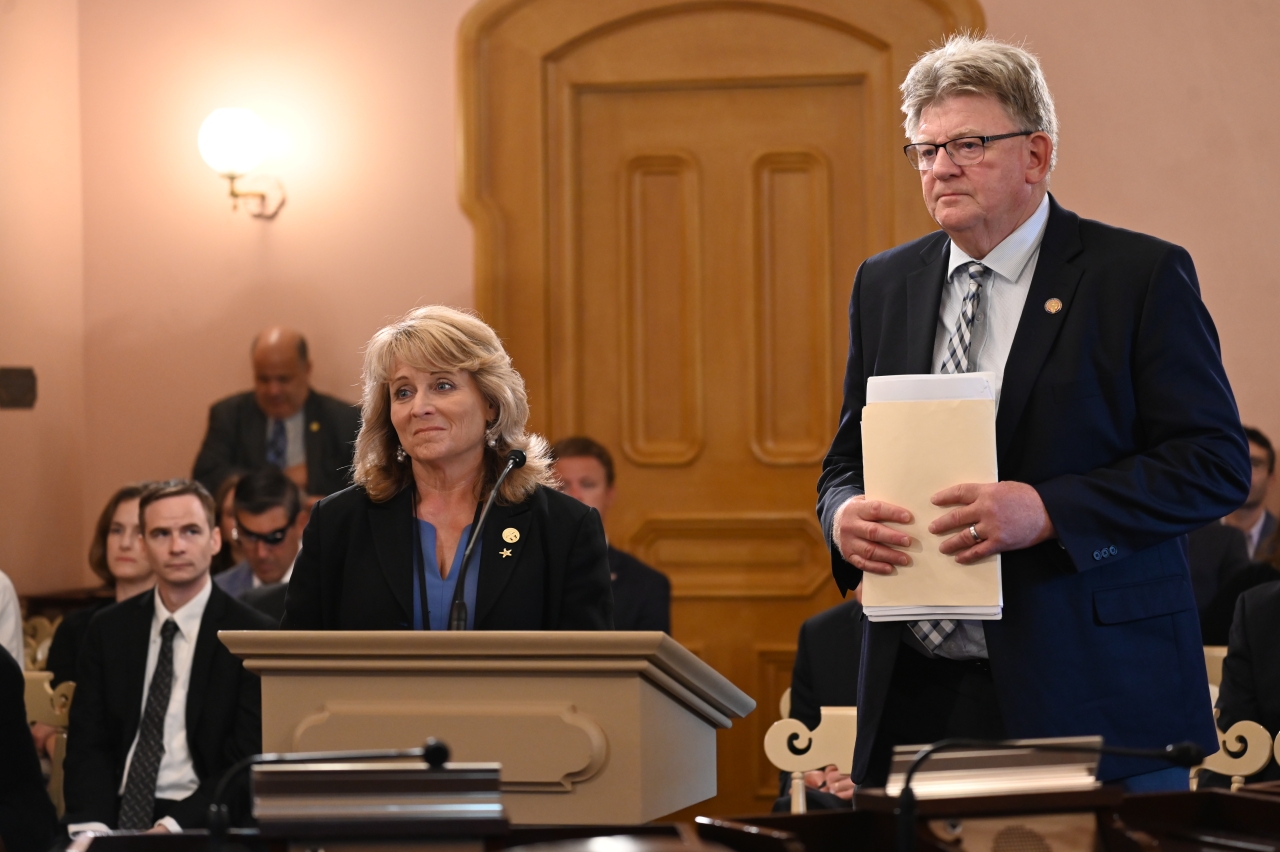
But Ohio’s lawmakers have been working on the legislation for years, and held a hearing Monday to listen to testimony in support of the bill, which would enable anyone – including renters – to participate in solar energy.
Republican Reps. Sharon Ray and Jim Hoops reintroduced the legislation in May, less than two weeks after the Senate gutted their previous attempt in an overhaul of the state’s energy policy. Ray and Hoops also introduced the bill in 2024 and 2023. Sen. Mark. Romanchuk (R) and Sen. Kent Smith (R) introduced the Senate version.
Unlike previous versions, which called for a community solar pilot program, this year’s legislation is technology-neutral. So technically any source of energy generation project could be in the program, so long as the project is under the program’s cap.
HB 303, would add the community energy pilot program into the state’s energy policy, enabling people to subscribe to clean energy without the need to put solar panels on their apartment, house or business. With community solar, the consumer subscribes to a portion of the electricity generated by a local community solar installation, receiving credits on their utility bills for the electricity produced by the facility.
The energy facility must generate renewable energy and have a nameplate capacity under 11 MW, or less than 21 MW if it is on a distressed site or a commercial or public rooftop. The bill mandates that the facility may not be controlled by an electric utility.
Lawmakers modified the bill from previous versions to require subscribers to live in the area of the community solar project.
According to a 2023 economic analysis by The Ohio University, community solar would generate an estimated $5.6 billion in gross output and $409.5 million in local tax revenues for Ohio.
“These local projects can simply provide energy at a cheaper cost, and that’s what assures that subscribers can receive lower bills at the end of the day,” Caroline Belmont, business development manager of Denver-based TurningPoint Energy, said during the hearing.
Similar to legislation underway in Michigan, Pennsylvania and Wisconsin, Ohio Republicans have been trying to pass community solar legislation for years. The last bill, SB 247, went through seven committee hearings spanning almost a year but never made it to a vote.
Across these hearings, 118 people submitted testimony in favor of the bill.
In contrast, opposition was limited to representatives from five companies:
- Utility American Electric Power (AEP): Has a long history of publishing studies funded by the coal industry about the cost of solar versus coal, according to the Energy and Policy Institute.
- Edison Electric Institute: The association representing all U.S. investor-owned electric companies. A promotor of “clean coal.”
- Consumer Energy Alliance: A front group for fossil-fuel corporations, mainly gas, according to Freedom of Information Act requests from Salon.
- Americans for Tax Reform: Conservative tax group that denies global warming and has a history of being financed by fossil-fuel companies to strategically undermine public trust in climate scientists, according to Greenpeace. Has long supported bills to repeal, weaken or freeze renewable energy standards and clean energy laws, according to the Energy & Policy Institute.
- Ohio Consumer’s Counsel: Residential utility customer advocate funded by utilities through a charge on ratepayer’s bills.
AEP said last year Ohio doesn’t need community solar because its deregulated marketplace gives consumers options to support renewable energy projects.
However, for consumers who wish to support renewable energy, their only option is to pick a utility that isn’t AEP, as AEP generates among the lowest levels of solar energy among Ohio’s utilities.
Of the 19 states with restructured energy markets, 15 (79%) have succeeded in adopting community solar legislation, and lawmakers are inching close in the remaining four. In contrast, less than 20% of states with regulated energy markets have passed community solar legislation.
In 2024, just 0.27% of AEP’s nameplate generation capacity came from solar, and 8.32% came from renewable energy overall. AEP’s largest source of generation is coal at 43.56%, according to AEP’s sustainability report. For comparison, 3.16% of Ohio’s electricity is from solar, according to the Solar Energy Industries Association.
“Utilities use cost shift as their boogeyman, and because utility rate making happens in a black box, it is hard for anyone to argue against it,” said Carlo Cavallaro, new markets director at Coalition for Community Solar Access (CCSA). “The reality is that research and numerous cost-benefit analysis from around the country show the so-called cost shift narrative is false.”
“The projects make efficient use of existing infrastructure and allow utilities to reduce and avoid certain ratepayer costs,” Cavallaro said. “Utility capacity and heat maps from HB 15 will help maximize the impact of these developments by allowing them to strategically deploy and further increase benefits of this program.”
HB 15, which Gov. Mike DeWine signed into law earlier this year, made sweeping changes to the state’s energy policies, including a requirement utilities to publish heat maps that track local power outages.
“Every program has costs, but every program brings benefits,” Cavallaro said. “Every rate payer will see the benefits here from this program.”
Many of the lawmakers’ questions were either to prepare for anticipated opposition from utilities or how they could garner support from their constituents.
“I’m prepping for when [the utilities] come in to oppose on this,” Rep. Adam Holmes (R), chair of the House Energy Committee, said when he asked for confirmation that subscribers would not lose money due to the monthly subscription fee if the project hypothetically went offline.
“That’s correct,” Belmont replied. “When we are developing these projects, let’s say the poles in this area are a bit older or the wires can’t handle as much energy and they’re becoming outdated,” she said, “we, as a developer, pay the upfront cost to upgrade those systems. So, the entire neighborhood really can benefit from those upgraded poles and wires and all the infrastructure on the distribution grid.”
“That creates a much wider benefit for everyone else in the neighborhood,” Belmont said.
What makes Ohio different
On it’s surface, it may seem like Ohio is facing the same uphill battle Republicans face in Wisconsin. However, Ohio is a restructured energy market (sometimes called “deregulated”), so its utilities don’t have monopolies over generation. Whereas Wisconsin also allows its investor-owned utilities to offer their version of community solar, in Ohio community solar is completely illegal.
Ohio stands as one of the last remaining states with a restructured market that has not yet enacted a state program.
“Utilities use cost shift as their boogeyman, and because utility rate making happens in a black box, it is hard for anyone to argue against it.”
Carlo Cavallaro, Coalition for Community Solar Access
For example, for Illinois utility ComEd, community solar “is a game-changer,” said Melissa Washington, ComEd senior vice president of customer operations and chief customer officer. Washington said the utility views its role as an enabler for growth, which is largely because ComEd does not own generation like many of its utility peers in other states.
Mryia Williams, Ohio program director for Solar United Neighbors, told pv magazine USA, community solar is “not at all” a threat to utilities in Ohio. “But our utilities will definitely come in and oppose it,” Williams said.
Williams said the utilities are just worried they aren’t going to be left with any business.
Sometimes utilities don’t oppose solar in public hearings, she said. “You know how it goes – they’ll go in and talk to the [legislators] either quietly in their offices or during these meetings that aren’t hearings.”
“It’s up to us to show them that there’s still going to be business for them,” she said. “The solar project developers will still pay for wires and poles, which is on a generation credit,” Williams said. “It’s not going to take away their distribution or transmission credits.”
Republicans for community solar
Republicans embracing community solar is not necessarily new, Jeff Cramer, the president and CEO, said, “but the fact that the party is coalescing around it, that is new.”
Wisconsin Republicans, for example, are currently reintroducing a community solar bill. Michigan Republicans introduced a community solar bill in an omnibus package over the summer. In Montana, the Republican-led Legislature almost unanimously passed a community solar bill, but it was ultimately vetoed by the state’s governor. Republicans also tried for community solar bills this year in Iowa, Missouri and Georgia.
“Once you get past all the politics of renewable energy and you just think about these concepts in the absence of those politics, there’s a lot for conservatives to like,” he said.
“Republicans are just getting more comfortable with what ‘all the above’ means,” Cramer said. In the past, Cramer said “all of the above” meant something different, but the more exposure people get to solar energy technologies, the more comfortable they become.
“It’s all about the framing of it,” he said. “When you start to say, ‘clean energy and renewable energy,’ well, they don’t necessarily care so much about that. Some of them do. Some of them don’t.”
“What compels the conservatives is when you start to talk about how solar energy is the cheapest levelized-cost of energy on the market, is also the fastest [to deploy], and can help save their voters and their constituents money,” he said, “that’s the kind of stuff that starts to perk their ear.”
The Ohio Legislature will next hear testimony from the bill’s opponents in the upcoming weeks.
᎒ Read this article in pv magazine. Read Rachel’s other articles published in pv magazine here.