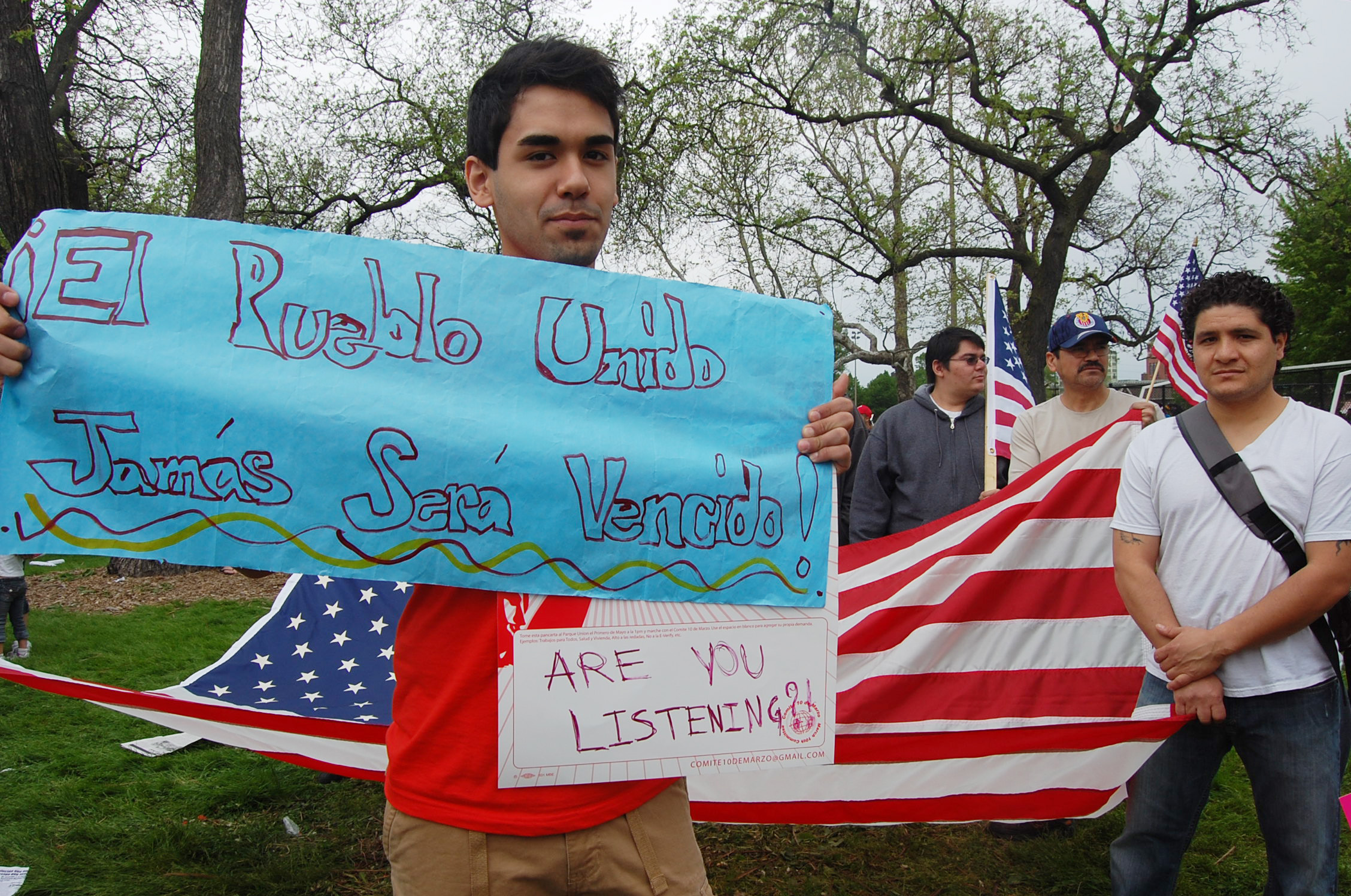
Gina Leal said she considers herself lucky. Born in Mexico City, Leal is not only a DePaul sophomore, but also a U.S. citizen. However, while Leal studies anthropology and Latino studies, 90 percent of her family remains in Mexico. While the new immigration law SB1070 applies only in the state of Arizona, it has had rippling affects to the students of DePaul University, including Leal.
“I am affected by this. I have family who will be separated,” Leal said. “Most of my family can’t visit because the government thinks that everyone who is coming is going to want to stay and take up resources and jobs. So I only get to see my family, if I am lucky, once a year because they are not allowed to come into this country.”
The Arizona bill, SB1070, would require local and state law enforcement to check the immigration status of anyone they suspect to be undocumented. The law makes it a crime for immigrants to not carry registration documents with them at all times.
Leal was one of more than 40 DePaul students to march from Union Park to the Daley Center on May 1 in protest of SB 1070.
The new law has been criticized by many who say it will bring forth racial profiling. The DePaul students who attended the march said it would give the police the authority to stop anyone with colored skin and profile them as an illegal immigrant.

According to SB1070, police need “reasonable suspicion” to ask for their papers. However, the officer may only do so if they have already stopped the person for a separate reason.
“The law in Arizona is giving people who aren’t European descent the message that yes, you are a citizen, but you don’t really belong here because you look a certain way,” Leal said. “It hurts. It’s the government’s way of telling us that we shouldn’t be here.”
Students with family in Arizona have said that no matter what side their family members are on, they are very vocal toward trying to persuade them to join them in their stance.
One student, who wishes to remain anonymous, said her cousin who lives in Arizona argues with many in favor of SB1070.
“Things have gotten out of control here,” said Alicia Summers, the student’s cousin who is an Arizona resident and 100 percent Mexican. “Arizona has no money. Schools are not getting paid for. Illegal immigrants aren’t paying for things the way I am paying for my child. It’s not right.”
Summers said that while many immigrants come to the United States for honorable reasons, “we can’t be sure that all of them are here to better their family.”
Summer argues that some people who come into the States from Mexico are murderers, and it is difficult to be sure who is good and who is bad. This is part of the reason, Summers said, Arizona had to form a militia to keep out illegal aliens.
DePaul students have also felt the law’s effect in American/Mexican relations.

Joel Lydic, a senior who is studying abroad in Merida, Mexico, said that for the first time since his arrival in Mexico, locals approach him with hostility.
“Folks here were incredibly friendly, kind and open-minded [and] have never said a bad word to me about the States – until now,” Lydic said. “Now, I am being asked to defend the U.S. every day.”
Universidad Autonoma de Yucatán, the school where DePaul students are taking classes, required all Mexican students to write reports on SB1070, even if it has nothing to do with the curriculum.
“It’s a very big deal down here,” Lydic said.
Dr. Lourdes Torres, a Latin American and Latino Studies professor at DePaul, said SB070 is nothing new in U.S. history. Torres said during the Great Depression, hundreds of thousands of people were picked up and deported to Mexico. This was only based on if you had brown skin.
“Most were not actually Mexican and had to find their own way home from Mexico,” Torres said. “Every time the country is doing bad economically you need a scapegoat. This is when people begin to blame the problem on immigrants.” Torres said this has happened every time the economy has had problems.
Sergio Garcia was among the students protesting the law on May 1. The freshman biology major has family in Arizona “who are very upset and considering leaving Arizona,” Garcia said. “It’s going to be a fight. We aren’t going to sit down and take it.”
Senior education major Crystal Pfeiffer also participated in the march but said her family in Arizona does not feel the same way she does.
“I do agree that is hard for us to say anything because we aren’t there. We don’t have people coming in all of the time,” Pfeiffer said. “I don’t think that a lot of the time people who live there are looking at all of the issues and how the United States has had an affect on bringing people here. Because I am not in Arizona it is hard for me to say you shouldn’t be doing this law, but at the same time, a lot of the arguments I’m hearing out of Arizona aren’t very sturdy.”
Lydic said he thinks the law will be temporary.
“I don’t think the law will last,” Lydic said. “In the meantime, I’m embarrassed for the state of Arizona.”
This article was originally posted in The DePaulia.

Leave a Reply