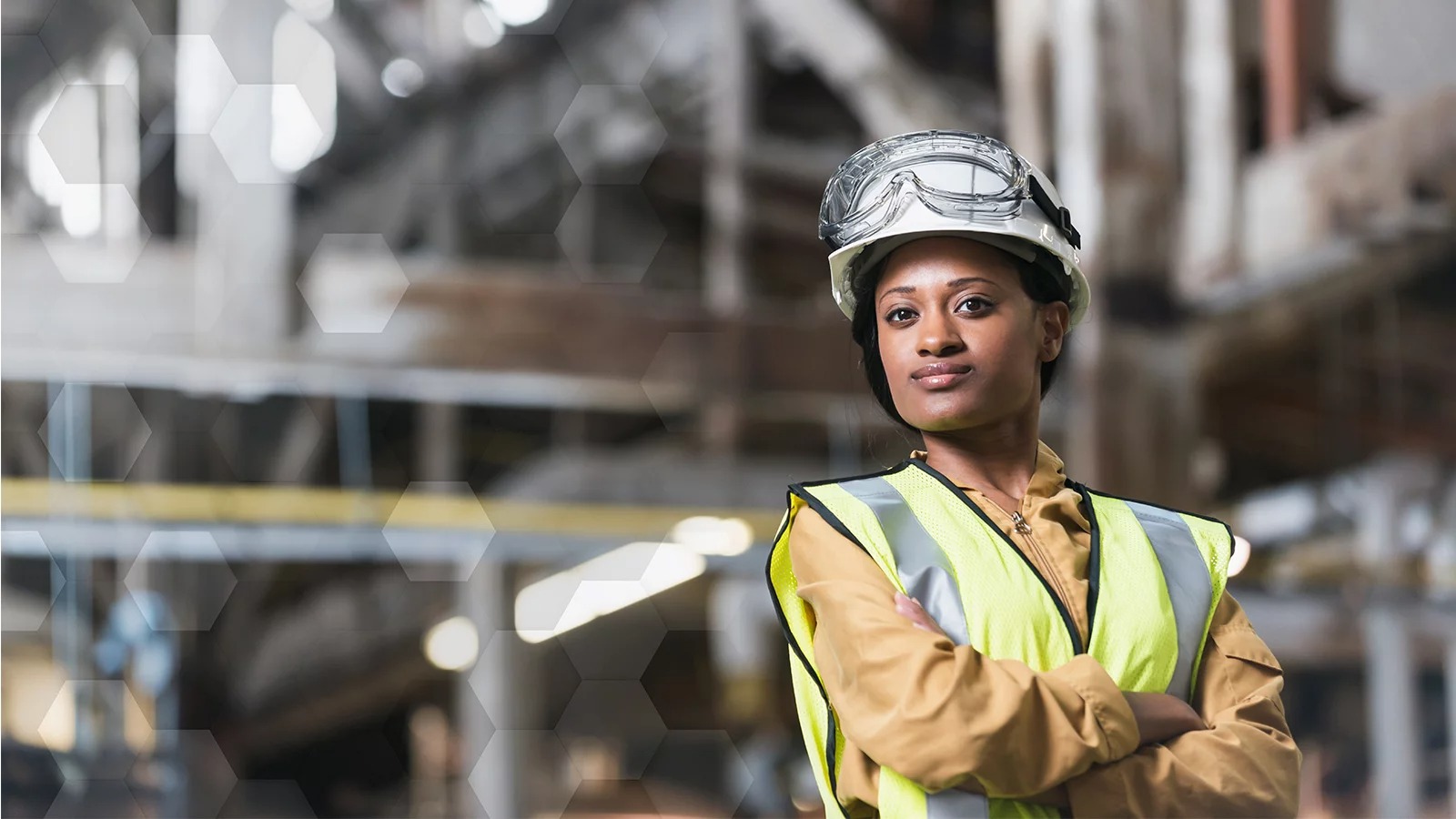
Hazardous occupations are dangerous for any worker. But for women, these dangers continue to be amplified because most companies continue to manufacturer their products as if women are smaller versions of men.
With clothing, “unisex” tends to be code for “made for men.” Studies find that unisex clothing is based on anthropometric data consisting mostly of men’s body measurements. Industries continue to approach garment sizing with a “unisex” approach. But from the neck down, nearly every part of the male and female body is differently proportioned. Unisex sizing is code for “made for men.” Unfortunately, this approach is putting female workers’ lives at risk.
If the glove fits, it is likely not on a woman’s hand.
Women in Dangerous Occupations
In 2016, women made up about 9 percent of the construction workforce (BLS 2017). Women’s participation in jobs that require PPE—such as firefighters (5.7 percent), construction laborers (2.5 percent), welders (4.8 percent) and chemical engineers (13 percent) is well below their participation in other nontraditional (male-dominated) jobs such as science, technology and engineering positions, architects and chefs, and well below overall workforce participation that is 51.7 percent female (BLS 2017).
However, although women make up 2.5 percent of the construction industry’s laborers, from 1985 to 2007 the number of women employed in the overall construction industry grew by 81.3 percent (DOL, 2016). According to the National Fire Protection Association (NFPA), 5.7 percent of firefighters are women, a 73 percent increase from 1983 to 2012. According to American Petroleum Institute, women are increasingly working in the oil and gas industry, accounting for 17 percent of oil and natural gas, and petrochemical industries’ workforce in 2015 (American Petroleum Institute, 2016).
Women are continuing to fit themselves into traditionally male-dominated occupations, however, as they continue to do so, many are reportedly stepping into workplaces primarily equipped for a male workforce. Women have fit themselves into a male-dominated industry that is still firmly fit to the male form. Without properly fitting PPE, women’s safety is on the line.
OSHA requires workers in hazardous occupations to be provided with PPE that properly fits each worker. A good fit is essential for PPE to protect the wearer, and in many cases, it can be a matter of life or death.
Despite this shortfall, companies continue to supply their female workers with men’s PPE in a small size. This can be due to ignorance, cost, or because for certain types of PPE, a manufacturer that makes female sizes has yet to exist, as is the case with electrical gloves.
Different figures
Women’s body measurements are often inaccurately regarded as miniature female versions of male bodies. However, male and female bodies are differently proportioned from one another and because of this, men’s apparel cannot be sized down and fit a women’s body. Stirling (n.d.) said that while some male body dimensions can be scaled down to females with some reliability, most parts—particularly the head, hands and feet–are differently proportioned, and thus cannot be scaled down to reliably fit a woman’s body.
PPE that cannot be sized down for female bodies
Gloves
- Women’s hands have shorter, narrower fingers and a smaller palm circumference.
- The average female hand length is 0.8 inches shorter than that of a man’s.
- On average, women have half the grip strength of men. (Fun fact: the reason women often have more difficulty opening jars than men is not because of strength, but because their finger-to-palm ratio gives them less torque.)
According to Ontario Women’s Directorate (OWD) and Industrial Accident Prevention Association (IAPA), on construction sites, which are known to equip women with “one-size-fits-all” PPE, often only order men’s large and extra-large gloves.
Shoes
Aside from diminished comfort, wearing shoes designed with male lasts has both short and long term health consequences. When comparing female and male feet, there are several significant differences:
- The average female foot is narrower.
- The ball of the foot’s width on female feet are wider in relation to the heel’s width.
- Women generally have a smaller and higher Achilles tendon.
- Female feet tend to have higher arches.
Women also have a shallower big toe, a lower instep, and a more curved inside line than men (Ontario Women’s Directorate, Industrial Accident Prevention Association, 2006).
Along with foot shape, women have a different foot pronation than men. Their wider hips mean they have a different angle that the foot strikes the ground, so they need extra support to help with the quad muscles. Women also require a softer and lighter midsole than men because women typically weigh less than men of the same height and shoe size.
Companies that provide false information on sizing women’s feet to men’s shoes include:
- Nike
- Zappos
- Famous footwear
- Flow feet
- DSW
- Keene (which goes so far as to claim “it’s the sizing that is gender-specific.”
- Nordstrom
- New Balance
Coveralls
The average female body is shorter in length, has narrower shoulders, and larger thighs and hips than male bodies (Ontario Women’s Directorate, Industrial Accident Prevention Association, 2006; Schmeidler, 2014).
Most men’s coveralls do not fit most women.
Fall protection harnesses
The average female body is shorter in length, has narrower shoulders, and larger thighs and hips than male bodies (Ontario Women’s Directorate, Industrial Accident Prevention Association, 2006; Schmeidler, 2014).
This difference also affects the angle the straps of fall arrest equipment fit into a harness and causes the average woman’s center of gravity to be lower than the average man’s.
For fall protection, studies have found that unisex harnesses do not adequately fit women. Due to women’s lower center of gravity (Schmeidler, 2014), male or unisex fall protection harnesses cannot adequately offer them the same protection that they do for men. An improperly sized harness hinders a worker’s movements and affects their ability to work safely. It also can increase the worker’s risk of “suspension trauma” after a fall. Hsiao, Freiss, Bradtmiller, and Rohlf (2009) used a 3-D elliptic Fourier analysis procedure of body scans, which suggests the D-ring location on unisex fall protection harnesses must be moved upward to adequately fit a female torso.
Glasses
Eyewear protection does not need to be designed around different anatomical proportions–all heads are round regardless of sex. However, companies often distribue eyewear as one size fits all, but women have a smaller head and face circumference than the average man.
Companies that manufacture safety goggles as “one size fits all” create a “serious health and safety hazard if gaps around the seal to the face allow flying objects, and particles, m, chemicals or other hazardous substances to enter the eye area,” OWD and IAPA say. “Fogging of the lenses (from poor ventilation) is common and can lead to accidents; Mishaps can occur if the wearer takes her goggles off to clear them and is hit by flying debris, or if she cannot see well enough to do her work properly.”
According to OSHA, “Many occupational eye injuries occur because employees are not wearing any eye protection while others result from wearing improper or poorly fitting eye protection.” https://www.osha.gov/sites/default/files/publications/osha3151.pdf
Menswear style in PPE
Functional fit and comfort are crucial in PPE’s design and usage. Despite OSHA’s General Industry Standard [Subpart I, 1910.132 (d)(iii), that requires employers to provide PPE “that properly fits each affected employee” women are usually provided men’s PPE in a smaller size.
OSHA said that inadequate or ill-fitting clothing, boots, gloves, or safety equipment presents a safety hazard for workers. The PPE industry is mostly tailored for men.
Almost half of all female OSH professionals say their employer provides them with PPE that does not fit them (Onyebeke, L. C., et al, 2016). About 71 percent of more than 3,000 survey respondents in a 2016 study by the Women’s Engineering Society (WES) and Prospect, a UK trade union said their PPE was not designed for women. In addition, more than half (57 percent) of these women said their PPE “sometimes or significantly hampered their work.” The results varied by sector: In the energy sector, more than 90 percent of women said their PPE was not designed for women and in construction, 83 percent said their PPE is not designed for female bodies. Trousers (41 percent) were most commonly cited among women for their improper fit. WES and Prospect conducted an almost identical survey in 2009 with nearly the same results, suggesting little improvement across the decade.
Kalyn Chism, a safety specialist for the U.S. Army Military District of Washington, said she has never been able to easily find PPE that fits her body.
“Safety vests are like sacks on me,” the five-foot woman said. “They are just so huge that I don’t feel very safe in them. I am afraid they are going to get caught on something when I’m working because they are just that big,” she said. Chism said she has lost track of the numerous safety vests she’s tried and yet, “I have not been able to find one safety vest that fit me.”
To select the best properly fit safety vest, Chism said she selects “whichever isn’t as huge as the rest.”
Women surveyed by Prospect (2016) said that ill-fitting PPE causes discomfort, which is especially heightened during pregnancy and menopause. About a quarter of their survey respondents had gone or were going through menopause, of which 38 percent changed duties and 4 percent changed roles because of the discomfort caused by their PPE.
“A majority of what is available on the market is conducive to a male anatomy and not a female anatomy. This is always a delicate issue,” Thomas Kramer, P.E., CSP, said. “When you see a number of harnesses being fitted on women as I have, oftentimes you get a couple different looks,” he said, “one is, ‘I’m not going to put on that thing,’ and secondly, once they put it on it shows how it can be very uncomfortable for them.”
Anthropometric methods
Anthropometric data consists of comparative body measurements, which are typically used to ensure products are designed to realistically fit most people. PPE is designed using the 5th to 95th percentile of male and female anthropometric data (Schmeidler, 2014). According to Stirling (n.d.), 90 percent of the people measured in an anthropometric dataset have a height between the 5th and 95th percentile values.
Anthropometric datasets are intended to be used to design products that will fit 90 percent of the population, so the smallest 5 percent and the largest 5 percent of the data is excluded when designing PPE. This is done because accommodating those people with measures at the tail ends of the distribution would drastically increase the length of that variable, and may mean the product will become very complex and costly.
It is a common misconception amongst designers that “for all practical design purposes women are scaled down versions of men, having a proportionate approximate body size of 93 percent of that of males on average,” Stirling said. A rule of thumb designers often mistakenly use is that a 50th percentile woman is equivalent in size to a 5th percentile man and that a 95th-percentile woman is equal in size to a 50 percentile man (Stirling, n.d.).
For example, many PPE suppliers’ sizing guidelines say to go two sizes down when converting men’s to women’s shoe sizes. The average female foot, however, is narrower than the average man’s and therefore it is not good practice to follow these retailers’ guidelines (Ontario Women’s Directorate, Industrial Accident Prevention Association, 2006).
In 2015, NIOSH developed the first database of firefighter body measurements. Prior to the database, manufacturers used body dimension data from 1950s military personnel. The new, modern dataset is intended for use by manufacturers’ PPE design. Of the body measurements used to collect the data, 863 were men and 88 were women. The new, modern dataset is intended for use by manufacturers’ PPE design and presents two potential issues for women seeking PPE:
- The data couples men and women together. With only 8 percent of the body measurements being female, it is unlikely that PPE designed around the data will be representative of the female form.
- The number of female body measurements collected in the data set is a higher proportion than the 3.5 percent of employed U.S. firefighters in 2016 (BLS, 2017).
As women continue to enter traditionally male-dominated industries, will this data remain current with the slow growth rate of official anthropometric data available to manufacturers in years to come?
Taking this into account, the measurements of a woman shorter than the average woman are likely to be excluded from a dataset, while a man shorter than the average man is likely to be included in the data. The dataset usually uses a male-to-female ratio that mirrors the demographics of the application’s industry and/or occupation. This creates a perfect storm for an underrepresentation of the already minority group’s data points.
Park and Langseth-Schmidt (2016) found scientific evidence of the anthropometric fit problems and discomfort of female firefighters’ PPE using 3D body scans. Their research is intended to bring change from the issue, “which is anticipated to help policymakers and the manufacturing industry enhance occupational safety regulations and improve fit and sizing systems, especially for female firefighters who wear uniforms designed based on the male physique.”
PPE designed using male body proportions, even in smaller sizes, can jeopardize the health and safety of female workers and their co-workers. OWD and IAPA cite several examples for how ill-fit PPE can jeopardize the health and safety of female workers:
- A woman with a small face wears the goggles available in the shop. The gaps they leave at her temples allow flying debris from her machine to enter her eyes.
- A female worker in a sawmill can only get small men’s sized gloves; the fingers are too long and too wide, the palm area too large, and the cuff allows sawdust to fill the fingers. She risks getting her fingers caught in machinery and pinched when she stacks or carries boards.
- A woman who wears men’s sized work boots complains of tripping while walking and climbing stairs or ladder.
When PPE does not fit or is uncomfortable to wear, Ontario Women’s Directorate (OWD) and Industrial Accident Prevention Association (IAPA) say that workers tend to avoid using it, regardless of the hazards doing so may create. “Employers concerned about the health and safety of the worker may be reluctant to hire or promote women whose safety is at risk,” their report said.
“It’s clear that one size does not fit all,” said Ontario Women’s Directorate and Industrial Accident Prevention Association (OWD, IAPA, 2006) after surveying more than 100 PPE manufacturers and suppliers in Canada and the U.S. and interviewing women who wear PPE at work, employers and union representatives and representatives from government, standard-setting agencies and specialists in PPE issues relating to women. Ill-fitting gloves were the “single, greatest problem noted by the participants,” OWD and IAPA found. Despite the fingers being too long and too wide, the palm circumference too large, and the gauntlet or wristlet too big for their hands, many of the surveyed women said they “simply make do” with gloves that do not fit. OWD and IAPA’s research participants said that correct glove sizes are difficult to find and that only men’s large and extra-large gloves are stocked at most worksites.
“With PPE that claims to be ‘quote, unquote: made for women’, unfortunately,” Schmeidler said, “it’s kind of like ‘buyer beware’.”
Shrinked and pinked
NIOSH said that tools and equipment, like clothing, are often designed to be used by average-sized men, but that the design of PPE for women should be based on female measurements. However, many PPE products that were designed from proportionately shrunk male anthropometric data and then labeled to be “unisex” or are marketed to women using a form of pinkwashing, the practice of making a product pink to illegitimately signal the product supports or is designed for women.
“Pardon me for saying this,” said Carol Schmeidler, MS, CSP, “but just because something is pink doesn’t mean it is appropriate for women. A lot of women I know wouldn’t wear anything pink, anyway.”
Chism is one of these women.
“In all honesty, I avoid ‘the pink’,” Chism said. “Just because I am a woman, doesn’t mean that I need pink PPE.” Chism said her biggest struggle with pink PPE is that it never actually fits. “They market women’s PPE to the color and not to the female worker,” she said and then added, “this also puts us in a box, which isn’t right either.”
For some women, the mere color of a pink product can create be hazardous. Some women say pink PPE prevents them from being able to camouflage into a male-dominated workforce where discrimination and the belief that women are unfit for the job might linger. Consequently, the woman may err on her career’s safe side and wear PPE that is a better fit for a man’s body.
According to Terri Piasecki, a former construction manager who now owns Charm and Hammer, a women’s PPE retail company, many women do not want to draw attention to their need for special accommodations. “They are afraid it will keep them from getting a job or stunt their career,” she said.
According to Prospect (2016), the PPE challenges women face “reflect the wider challenges faced by women working in male-dominated industries,” the union group said. “In male-orientated areas of work, women are already facing an uphill battle and when they ‘start making a fuss about PPE’ it is seen as being disruptive and going against the ethos of the existing work culture, i.e. someone you wouldn’t want in your male-orientated team.”
Although OSHA requires employers to provide workers with properly fitting PPE, not all women are willing to notify their employer when their PPE does not fit properly because as minorities within a male-dominated industry, they are “plagued as a phenomenon known as ‘stereotype threat’ [ … ] with the belief that others think they are incapable” (Wangle, 2009).
This is particularly true for companies that buy their employees’ PPE in bulk.
Some women, particularly those who work in all-male sites, are reluctant to draw attention to their special needs. With a relatively small female component in traditionally male-dominated occupations, many manufacturers are reluctant to invest in the necessary research and development to produce correctly sized and proportioned products. The result, ill-fitting protective equipment, can jeopardize the health and safety of female workers and their co-workers (OWD, IAPA, 2006).
Chism said she has felt discriminated against in the past because of her improperly fit PPE. Partially, she said, it is because of her size.
“They think ‘okay, well can she do the job, can she stand up to big guys and do safety work?’ And then they think ‘how we are going to accommodate her size in regard to safety and PPE?’, which is challenging within itself,” she said. “I think that many employers don’t think about that aspect of it. They are used to working with the big guys that have access to standard PPE, and then here I come along and I don’t fit the standard mold.”
Whether or not PPE has a role in discouraging women from entering these professions has seemingly not been researched, but it is safe to say that this lack of access certainly has not helped, and might be a contributing factor in the slow growth of women in jobs that require PPE, relative to most other male-dominated professions.
According to Cristine Fargo, ISEA’s director of member and technical services, part of this has to do with the culture of the institution in which women work. “Perhaps women do not want to draw attention to themselves by speaking up, or perhaps they are not part of the decision-making process,” she told Professional Safety in 2013. “They may be unaware that PPE solutions exist that could overcome the ill fit of products they currently use. In some companies, PPE selection decisions may be made in the purchasing department, rather than by safety professionals. That fosters a one-size-fits-all approach, and workers are expected to wear whatever the company buys.”
“This is about safety,” Piasecki said. Piasecki said she noticed a “lack of gear immediately available for women in the field” when she was a safety and risk manager from 1990 to 2002. She knew PPE designed for women existed, but that it was not easily findable or accessible to women. To address this hole, Piaski quit her job and created charmandhammer.com, a niche retail store that sells PPE fit for women. A growing number of such companies have popped up over recent years, which has helped employers find PPE fit for their female employees.
But on the glove’s other hand
However, not all PPE can be easily designed to properly fit the average woman’s body while still ensuring safety. ANSI/ISEA 107-2015 requires high visibility apparel to be made of a minimum amount of square inches of reflective material, which is divided into classes based on its expected work environment (such as the speed of surrounding motor vehicles) and work activities. The required area of fabric is not set in relation to the worker’s body measurements, which traditionally forced smaller workers to wear oversized garments. According to Piasecki, this can create an almost impossibly safe situation for smaller workers who cannot wear enough visibility background material in high-speed traffic areas while also wearing PPE that is not too baggy for their body.
“If you are too small to fit into that equipment, especially a high-vis apparel that is necessary,” Piasecki said, “then you are probably too small to fit in that job. That’s just a safety issue,” she said, adding, “but, this is rarely discussed … rarely. I’ve never heard anyone discuss it.”
Piaski said there are some manufacturers who have found a workaround to the high-visibility square-inch requirement that still maintains safety. “The manufacturers took what women have been doing, taking material off of the bottom of the vests, but then put it on the side so that it would still follow OSHA’s square-inch requirement,” she said. “It was genius. It is just an example of someone thinking out of the box.”
This issue reportedly imposed debate among the ANSI/ISEA 107 committee when they revised ANSI/ISEA 107 in 2015, but the committee eventually decided that a correct fit was safer and more effective than an improperly fit garment with a slightly smaller high-visibility background. Consequently, ANSI/ISEA 107-2015 includes a footnote that notes that Type R, Class 2 garments can have a slightly smaller background material to accommodate smaller workers (ANSI/ISEA, 2015).
Cristine Fargo, the director of member and technical services of the International Safety Equipment Association (ISEA) said that ISEA and its member manufacturers had been continually asked for high-visibility solutions that would enable the worker to be visible, but also not expose them to catch hazards or interfere with other protective gear that might compromise their safety. “The change in the industry standard to allow a reduced amount of background material for the smallest sized offered is a direct result of these requests received from end-users who expressed concern regarding properly fitting garments for smaller sized workers, including women,” she said.
Women want to see an equivalent range of women’s sizes as in men’s as a standard, an appropriate and accurate measuring system and/or place where PPE can be tried on, more employers making an effort to match better practice in other companies (Prospect, the Women’s Engineering Society (WES), Women into Science and Engineering (WISE), Trades Union Congress (TUC), 2016).
OWD and IAPA’s survey participants suggested several ways in which the government can help to improve the PPE situation for women:
- increase the number of government inspectors to ensure regulations are being complied with;
- increase fines to foster compliance;
- exert pressure on employers to, in turn, pressure PPE providers into making women’s equipment more available; and
- develop more regulations that are specification-based.
ASSE’s Women in Safety Engineering (WISE) held a focus group in 2016, which determined that many of the ill-fit PPE problems continue to exist. After their study, the group held a stakeholder meeting to discuss potential solutions. According to WISE, the consensus of the stakeholders was:
Most contractors and unions are not mindful of the issue, and it is unlikely that many of those in charge of purchasing safety equipment consider purchasing PPE designed for women. Participants agreed that to bring about necessary changes, we must first increase awareness within the industry of the challenges female construction workers face. Somewhat surprisingly, even though there have been attempts to raise awareness, such as the OSHA Women in Construction web page, a few stakeholders said that they had not been mindful of the PPE issue confronting female construction workers.
More than a quarter of surveyed women say they had been subjected to comments as a result of ill-fitting PPE, most of it derogatory (WES and Prospect, 2016). Women reported that coworkers compared them in their PPE to MC Hammer, a Teletubby, a sack of potatoes, Sponge Bob Square Pants, an Umpa Lumpa and so forth.
However, these shots fired likely due to an unhealthy workforce and not the PPE itself.
The next step forward
The issue of female PPE was first publicly acknowledged almost thirty years ago. Since then, the issue has been covered time and time again by government agencies, news outlets and OSH professionals. Despite this awareness, however, little progress has been made as the number of women who reportedly wear ill-fit PPE remains in a steady majority.
PPE styles generally come to fruition based on supply and demand, and the increase in the supply of PPE for women has reflected an evolving workforce. Approximately 75 percent of more than 100 manufacturers and suppliers surveyed by Ontario Women’s Directorate and Industrial Accident Prevention Association reported an increase in requests for PPE in women’s sizes or in size ranges suitable for women from 2003 to 2006. Thus, the number of PPE available to women has increased, but the number of women wearing properly fit PPE has not.
“I think flexible manufacturers, I think probably in the age of 2D printers and Just-in-Time manufacturing it might be a problem that’s a little more solvable at a little less cost,” Schmeidler said, “If we are able to get a little more women into professions that require this type of PPE … again if we have a profit-motivated market supply the people who are manufacturing these things with the need to manufacture and sell them, and they’ll do it. It’s kind of a circular argument, but if we have more demand for it then there is going to be more motive for supplying it,” Schmeidler said.
Common PPE, such as safety glasses, hearing protection, coveralls, lab coats and gloves should be made and stocked in smaller and more assorted sizes, Schmeidler said. “It’s a workable solution that is not cost-prohibitive, and yet,” she said, “we see so many laboratories that have mediums, large and extra large, but nothing small.”
According to Schmeidler, fall protection harnesses that are specifically made for women are currently “very difficult to find,” she said. “Mainly because the number of women requiring fall protection is probably so small that it is a very lucrative market at this point,” Schmeidler said. “Until there is more of a market more of a need for them, I don’t think there’s going to be more development, unfortunately,” she said. “Hopefully that will change.”
One likely solution in the near future is in the design of fall protection harnesses, which might eventually be based on separate sets of male and female anthropometric data. It seems that without the demand for a supply, ANSI standards are the most likely solution in ensuring safety for all workers.
“A standard for gender and body type is where we want to move in the future,” said Kramer, who serves on three ANSI/ASSE committees, including Z359 (Fall protection/arrest). The need to “address the category of females better” was briefly brought up at a Z359 meeting in early 2017 during a discussion on how to make fall protection standards better for lightweight workers, many of whom happen to be female, Kramer said.
Another direction Kramer said he sees ANSI fall-protection standards “moving toward in the future—and this would start out with ANSI and then maybe in decades go over to OSHA,” he said, is for each person who uses the harness, there would be a medical evaluation and fit testing required by each person using it, which is very similar to what is already required by the respiratory standard,” he said. “When it comes to fall protection, we aren’t just looking at losing an eye or getting a broken ankle or foot,” he said.
“It could potentially be a life and death issue, he said. “So, if we are truly going to be serious about it, let’s do it,” Kramer said. “The reason why more people don’t get hurt isn’t that they are using their fall protection equipment correctly, it’s because they simply don’t fall. It is good luck—not good work practices, that is keeping people safe right now,” he said.
“As a standards development committee, we will have to figure out how to quantify a good fit and put that in some terms that could then be executed by an employer,” Kramer said.
Although standards development is notoriously slow, Kramer said he believes this will absolutely happen within our lifetime. There is a model relative to respirators that we can build from,” he said, “the shape and the contours of the body are much different, so obviously, it will be much more challenging for the medical side [to quantify anthropometric data], we can repurpose a lot of those questions from the respiratory standard. The big heavy lifting of developing such a standard, Kramer said, “is how do we know what a proper fit is?”
Manufacturers already talk about properly fit equipment in their manuals, Kramer said, so I think it’s about looking at what the best characteristics are from each of their manuals and using it to create a best practice with that information. Therefore, Kramer said it might start as a best practice or voluntary document at first, but as people start to use it, “we will learn and apply it, then we can bring it into the requirements part of the standard employers,” he said.
Although there has not been a formal discussion on incorporating gender-specific body measurements into fall protection standards among the ANSI/ASSE Z359 committee, Kramer said.
“It just takes someone who is passionate about it,” he said, “and I just might be that somebody.” And after a long pause, Kramer said, “I might do it.”
References
American Society of Safety Engineers, Women in Safety Engineering (2016). PPE for Female Construction Workers. Retrieved from https://wise.asse.org/assets/5/17/Word-WISE_0316.pdf
ANSI/ISEA. (2015). High-Visibility Safety Apparel and Accessories (ANSI/ISEA 107-2015). Retrieved from http://www.asse.org/ansi/isea-107-2015-american-national-standard-for-high-visibility-safety-apparel-and-accessories-electronic-copy-
American Petroleum Institute (2016). Minority and Female Employment in the Oil and Natural Gas and Petrochemical Industries, 2015-2035 (Report No. DM2014-015). Retrieved from http://www.api.org/~/media/Files/Policy/Jobs/16-March-Women-Minorities-Jobs/Minority-and-Female-Employment-2015-2035.pdf
Ontario Women’s Directorate, Industrial Accident Prevention Association (2006). Personal Protective Equipment for Women – Addressing the Need. Elcosh.org. Retrieved 26 January 2017, from http://elcosh.org/document/1198/d001110/Personal%2BProtective%2BEquipment%2Bfor%2BWomen%2B-%2BAddressing%2Bthe%2BNeed.html?show_text=1
Hsiao, H., Freiss, M., Bradtmiller, B., Rohlf F. J., Rohlf, F. J. (2009). Development of sizing structure for fall arrest harness design. Ergonomics. http://dx.doi.org/10.1080/00140130902919105
Ontario Women’s Directorate, Industrial Accident Prevention Association (2006). Personal Protective Equipment for Women: Addressing the Need. Retrieved from Electronic Library of Construction Occupational Safety & Health: http://elcosh.org/record/document/1198/d001110.pdf
Onyebeke, L. C., Papazaharias, D. M., Freund A., Dropkin, J., McCann, M., Sanchez, S. H., Hashim, D., Meyer, J. D., Lucchin, R. G., Zuckerman, N. C. (2016). Access to properly fitting personal protective equipment for female construction workers. American Journal of Industrial Medicine, 59, 1032-1040. doi: 10.1002/ajim.22624
Department of Labor. (2017). Current Population Survey [Data file]. Retrieved from https://www.census.gov/programs-surveys/cps.html
Park, J., Langseth-Schmidt, K. (2016). Anthropometric fit evaluation of firefighters’ uniform pants: A sex comparison. International Journal of Industrial Ergonomics, 56, 1-8. Retrieved from http://dx.doi.org/10.1016/j.ergon.2016.08.011
Prospect, The Institute of Mechanical engineers Support Network, The Women’s Engineering Society, Women in Science & Engineering, Trades Union Congress. (2016). Women’s Personal Protective Equipment: One Size Does Not Fit All (Report No. 01299). Retrieved from https://library.prospect.org.uk/id/2016/June/21/Women-PPE-One-Size-Does-Not-Fit-All
Schmeidler, C. (2014). Construction Safety Management and Engineering (2nd ed.). Des Plaines, IL: American Society of Safety Engineers.
Stirling M. National anthropometry survey of female firefighters. Amington, UK: Chief and Assistant Chief Fire Officers Association; n.d. Retrieved from http://humanics-es.com/FireFighterAnthropometry.pdf
U.S. Department of Labor, Bureau of Labor Statistics (2016). Highlights of women’s earnings in 2015 (Report No. 1064). Retrieved from https://www.bls.gov/opub/reports/womens-earnings/2015/home.htm
U.S. Department of Labor, Bureau of Labor Statistics (2017). Household data annual averages: employed persons by detailed industry, sex, race, and Hispanic or Latino ethnicity. Retrieved from https://www.bls.gov/opub/reports/womens-earnings/2015/home.htm
Wangle, A. M. (2009). Perceptions of traits of women in construction (Master’s thesis). University of Florida, Gainesville, FL.
Leave a Reply