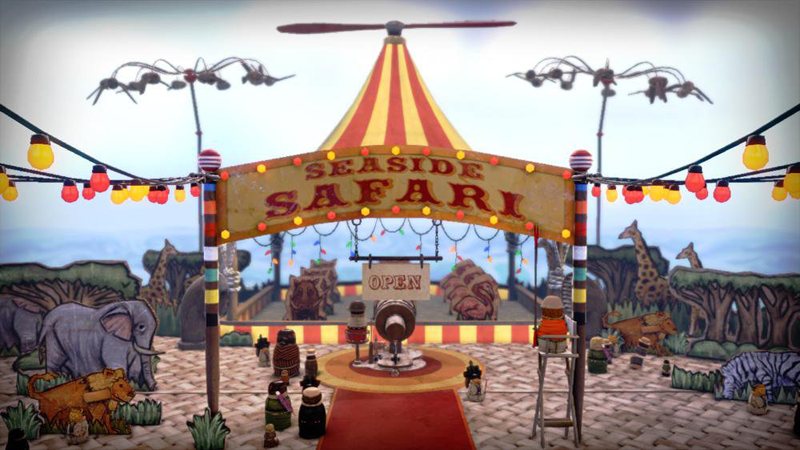
Tim Schafer is renowned for his creative video design. Shafer’s San Francisco-based video game company, Double Fine Productions, awaken a whimsical, but slightly dark artistic style within their games–imagery rarely captured by the industry’s go-to warfare narratives.
Schafer serves on the advisory board for the Smithsonian American Art Museum’s upcoming exhibition, “The Art of Video Games.” Despite Schafer’s cult following, Schafer says his company still struggles to make payroll.
“My goal has always been to bring things to games that are not typical to games,” he says. “Games have a very standard art style,” Schafer says, “like muscly, space marines, veins in their neck and you know, big guns.”

Double Fine Production’s concept art for “Stacking”. Image Courtesy of Double Fine.
“More inspiration is needed on the art side of video games,” says Nathan Martz, who was the project lead for Double Fine’s recent October release “Sesame Street: Once Upon a Monster“. Most video games are very drab, Martz says. “They are realistic but post-apocalyptic.”
Consumers in the U.S. reportedly spent an estimated $4.5 billion on video games in Q2 2011, according to market researcher NPD. The popular “post-apocalyptic” style described by both Schafer Double Team Technical Director Nathan Martz was not used in Nintendo’s colorful New Super Mario Bros., the top-selling video game of 2010. The style, however, was used in both the second (Call of Duty: Modern Warfare 2 by Activision) and the third (Battlefield: Bad Company 2 by Electronic Arts) top-selling games of that same year.


Electronic Arts’ “Battlefield: Bad Company 2” (left) and Activision’s “Call of Duty: Modern Warfare 2″ (right) were the second and third top-selling video games in 2010, respectively.
Double Fine’s “Psychonauts” received more than 15 awards in 2005. The majority of which fell into two honorable, but distinct categories: the “Best Game No one Played” and the “Overall Game of the Year”/”Editor’s Choice” award. The game is beautifully refreshing, but not enough for what Schafer calls the “cash cows.”
The big question, Schafer says, is how to make a game that is both artistically different and profitable.
“We always think that if we make a game look beautiful and make it look interesting then a lot of people will come play it,” he says. “But, sometimes it seems that games that just look like other games sell better.”
Martz says there is “constant pressure” for the company to sacrifice its artistic style.
“Sesame Street: Once Upon a Monster,” which was developed for adults to play with children and published by Warner Bros. Interactive Entertainment, did not need to be stylized to appease its ranging age groups because, according to Martz, “real creative quality is often not age-specific.”

Image courtesy of Warner Bros.
“Art is one of the most important tools for telling you how to feel,” Martz says. “Because it is such a powerful tool, we used it to set the emotional tone of the game.”
Double Fine’s Sesame Street video game is the company’s first product based on a licensed property. Schafer says they knew Sesame Street’s familiarity with people would help broaden the game’s audience.
“If you are going to do a license,” Schafer says, “you shouldn’t do something that is a cheap cash in. Sesame Street is something that has a higher purpose. They are there for the good of children and they really want to do good in the world, so I think they were a great partner for us to have.”
“We also have a very big soft spot for the cookie monster, so it just had an appeal to us,” says Schafer, who is the father of a 3-year-old girl.
Schafer says it can be really difficult to predict why or what people are going to like. “But for the most part,” he says, “we are just trying to make games that look good and will appeal to people. We might not have the same taste that the vast majority of people have, but I think a lot of interesting stuff becomes a mass hit all of the time.
“Video games aren’t like movies where everyone goes to the movies, Schafer says. “There is a kind of movie for everybody: A romantic movie, a comedy, a movie your grandparents like, and a movie little kids like … games aren’t like that yet. Mostly, some are action games or some are puzzle games. They are limited in number for different types that people can go to.”
Schaffer admitted that this is changing, noting how the invention of mobile apps and Facebook games lead many people to dabble in games who are not typically “hard-core gamers.”
“The video game industry is broadening out,” Schafer says. “But, I would like to see it broaden out in ways different than Farmville or Angry Birds, to just broaden out in terms of deeper narratives and characters, and fantasy worlds that are unique, fun to go to, and interesting and thought-provoking,” he says, adding, “all of those things that great books and movies are.”
The company is currently working to develop mobile games. Both Schafer and Martz would not discuss further details as to what games they are currently developing. Developing mobile games is “a strictly business move,” Schafer says. “To be honest, we are just trying to see if that’s an area where we can make money.”
Schafer says his mobile games will encompass the narrative style typical of Double Fine games. “We just first want to see if we can sell any and if we can make money,” he says. “Of course, we don’t want to do anything that wouldn’t be in our style so it would still have our sort of quirky art style and sense of humor.”
“But mostly, we are just an independent company that is trying to stay alive,” Schafer says. “We try to stay true to the things we care about, but we are also trying to make payroll every week,” he added.
“It’s funny to say that originality and creativity are at odds with commercial-ness,” Martz says. “That is often true, but if you look at any big break out- usually it is original. When enough people try out new ideas and they catch hold, they become what people copy. “We try to lead that by having ideas that are strong and worth making.”
Leave a Reply