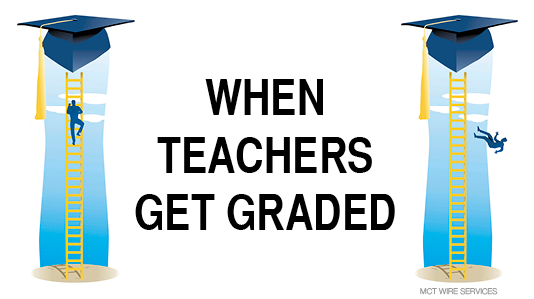
When students receive bad grades, professors often say they are the ones to be blamed by the students. But when the student gets a good grade, they take full credit. When the tables turned and it came time for DePaul’s school of education to be graded, the faculty cooperated– that is until their undergraduate elementary program received a C+ and their graduate program earned an F. Then the fights broke out.
That was last November. Now, the National Council on Teacher Quality (NCTQ), the advocacy group responsible for the investigation, has geared up for round round two of evaluations, this time in partnership with U.S. News & World Report. Many colleges, DePaul University included, have reacted with public outcry claiming the report’s methodology is unfair and inaccurate.
NCTQ collected information such as the curriculum, admission standards, and textbooks used from colleges across the nation. The department chair of teacher education at DePaul, Roxanne Owens, said the program, which collected only a sample of data from each category, did not collect enough information in each area to be deemed as credible.
“They said we didn’t prepare the teachers for the challenges of having bilingual students,” said Owens when claiming why DePaul’s graduate program failed the evaluation. She said that because the NCTQ did not collect all of the information, they were unable to see that students actually receive bilingual endorsements.
But contrary to Owens’ claims, DePaul’s F had nothing to do with the bilingual information they provided, said Arthur McKee, the managing director at NCTQ. “DePaul was notable in the Illinois education programs in that it does not provide any courses in reading instruction” he said. “We are giving DePaul a failing grade because there are a number of standards they failed to meet.”
DePaul tries to keep it hidden that they do not require graduate students to take courses on how to teach reading, McKee said.
“There are some things we know are really, really important and that’s teaching reading, which DePaul’s graduate program does not teach,” he said. “That’s why we feel so strongly about DePaul.”
While Owens, along with other school of education faculty members, said the NCTQ’s methodology was inaccurate, according to McKee, the NCTQ presented DePaul with their preliminary findings last year. DePaul, who McKee said was cooperative at the time, informed them that there were a couple of things wrong in the report.
“We actually changed four of our ratings in response,” McKee said.
The DePaulia obtained a listserv email conversation between DePaul’s Dean of Education, Paul Zionts, and the NCTQ (left). In response to the listserv, the president of NCTQ, Kate Walsh, sent an email to DePaul’s Dean of Education (right):
In one of the classes NCTQ looked at, the adjunct professor used a textbook that McKee said didn’t cover the essentials.
DePaul responded by saying that basing their grades on just one section of a class taught by an adjunct professor is unfair and shouldn’t be used to represent the entire school of education.
“The U.S. News & World Report methodology proposed is sort of similar to a student coming to a class to submit a ten page paper and the professor says, ‘okay–just give me page two, page five, and page eight, and that’s what your final grade will be based on for the course,” Owens said.
Owens was not the only member from the school of education to argue their grades were unfair.
“Poorly collected data rarely contributes to the improvement of quality,” said Education Professor Ronald Chennault.
However, McKee said DePaul’s justification, that a textbook with a section omitting the essentials is “just one section” or, “well that professor is just an adjunct” is unconscionable.
“We shouldn’t be able to choose a section of a course randomly and have it be something that is wrong,” he said. “The fact that they are not controlling what is being taught is pretty serious. It is fundamental to their education and shouldn’t be left up to chance.”
Owens said colleges’ criticisms are because “they are not used to this kind of scrutiny.”
DePaul’s Dean of Education, Paul Zionts, is “not doing what it takes to prepare teachers to go into the classroom. He is not doing a good job,” McKee said.
Owens said many people believe the NCTQ has hidden motives. “We have nothing to gain by producing low quality teachers,” Owens said. “I don’t know any university dean or chair who doesn’t want to assure that we are providing a high quality education to our future teachers. We owe this to our students.”
One theory is the NCTQ has members who are in favor of more alternative certification programs, Owens said. “There could be a bias of making these programs look better than a university program,” she said.
McKee denied these allegations and said, “We strongly believe that high quality education is fundamental in improving education in the United States.” The only way to improve the quality of teachers is to improve the quality of teacher preparation in large colleges and universities, McKee said, and the only way to do so is to differentiate the teacher programs from one another.
“Northwestern is particularly well and they need to be noted as such,” he said. “On the other hand, there is DePaul- which is not doing what they need to do to prepare students to teach.”
“The purpose of this investigative effort is to merit the institutions that are doing a good job,” Mckee said. “We aren’t out there to attack anyone.” According to McKee, many superintendents have told the NCTQ they have to essentially retrain teachers to be effective. “We have a very weak system of accountability for schools of education in the United States,” he said.
DePaul was not the only school to receive low marks. Columbia College’s undergraduate program received a D, University of Illinois at Chicago was given a B, and although Loyola University of Chicago’s earned a B-, similar to DePaul, their graduate program failed.
“There are a lot of institutions that for whatever reason have good reputations, but if you don’t scratch the service then how do you know,” said McKee, “Really, you don’t. People just say that because everyone else has talked about them being a good school.”
“A good reputation does not mean they are doing a good job,” he said.


Leave a Reply to Anonymous Cancel reply