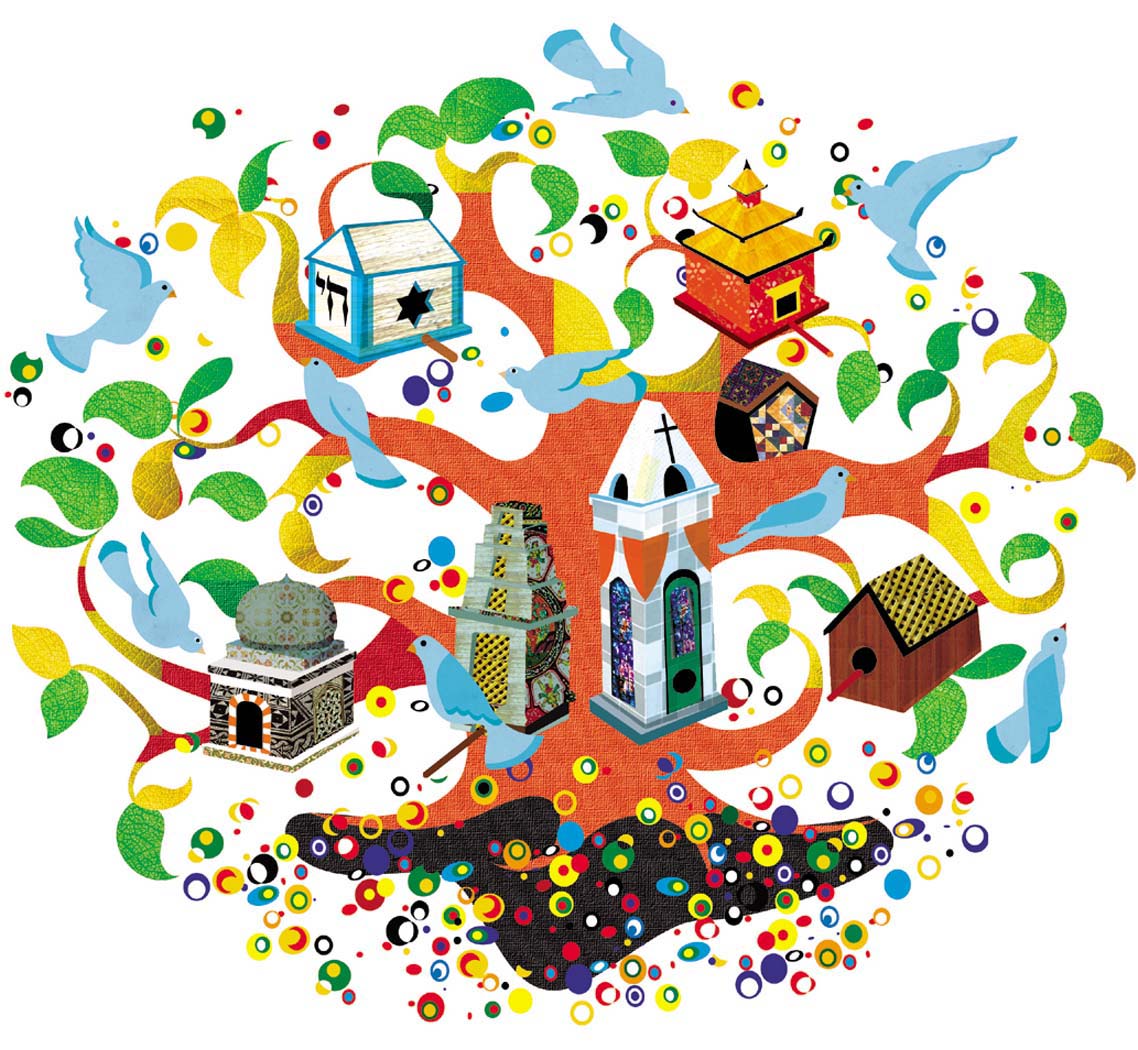

The average American doesn’t know basic facts about world religion, according to a recent Pew Research Center survey. America’s lack of religious knowledge has led many to question whether world religions should be taught as objective, academic inquiries in public schools.
According to the Pew Research Center (PRC), Americans were able to correctly answer 50 percent of basic questions about a number of faith traditions. About half of those surveyed knew the Koran is the Islamic holy book, that the Dalai Lama is Buddhist, and that the golden rule is not one of the Ten Commandments.
On questions pertaining to the Bible and Christianity, Jewish people scored the highest while Catholics fared the worst. Overall, only half of Christians were able to correctly answer questions pertaining to their faith. Only 23 percent of those surveyed knew that public school teachers can read from the Bible as an example of literature.
America’s lack of religious knowledge goes hand-in-hand with a separate PRC study that revealed the U.S. is the world’s most religious industrialized nation. According to the Sept. 28 report, nearly six-in-ten American adults say religion is “very important” in their lives.
The PRC report was not the only instance when concern over Americans’ religious knowledge has arose.
The Chicago Council of Global Affairs (CCGA) released a report earlier this year that said “all too often, Western powers fail to appreciate the consequences of many international conflicts because the religious resonance is so poorly understood.”
“However, Americans can also employ religion in a way that is irresponsible, wrong, and can escalate tensions,” the report said.
Claiming that a narrow view of religion will no longer suffice, the report said that religion must be seen as a social reality that shapes and is shaped by violent conflict and war, globalization, and democratization.

Fr. Anthony Dosen, a priest and education professor at DePaul said he advocates a more comprehensive education of world religions and Christianity because different belief systems impact how we do things. “We make decisions on foreign policy with no clue to what is going on religiously in some of these countries,” Dosen said. Such misunderstanding can ignite a powder keg of issues, he said.
At DePaul University, undergraduate students are required to take at least two religion classes in the domains of Religion and Ethical Questions and Religious Traditions. Although it is the nation’s largest Catholic university, the courses offered explore many different religions and perspectives.
Fr. Holtschneider, said that from his point of view there are two reasons that DePaul students are required to take these religious classes. “There is barely a day when the New York Times does not carry a story about a place or an issue in the world in which religions play a role,” he said. “To be an active member of our world, one must understand the great religions of the world.”
“DePaul is a faith-based university that believes that religion can play a powerful role in a person’s life,” Fr. Holtschneider said. “Our religious studies courses do not attempt to convert students, but they do offer an intellectual and adult study of religion in a way that enables students to understand these great faiths from the inside perspective of those who practice them and find them a source of meaning.”
With similar reasons to why DePaul embeds religion classes into its curriculum, many students and faculty members have said world religions should also be objectively taught in public high schools.
The president of the DePaul Alliance for Free Thought, Brandi Stepp, a senior, said that it is important to understand how religious policy affects social issues. “In a world where we are continuously fighting over LGBT equality and sex education, people should understand the role that churches can play in said debates,” she said.
The DePaul Chair of Religious Studies, James Halstead, said public high schools should teach about different religions. “If a high school curriculum studies people, the student ought to learn about the stories, rituals, beliefs, and values by which people live, and for which people are willing to die.”
While devotional Bible study is prohibited in public schools, many teachers will use it as a piece of literature when teaching in the classroom. The Bible is taught in 43 states, according to the Bible Literacy Project, which publishes The Bible and Its Influence, a student textbook designed for public school courses on the Bible. Such states, however, are not required to offer comparative religious classes or study of other religions, and many do not provide other offerings to Jewish, Muslim, and students from other religious backgrounds.
This fall, Oklahoma implemented HB 2321, a law encouraging public school districts to offer Bible literacy courses. Georgia, South Carolina, Tennessee, and Texas all have laws that call for Bible literacy in public schools.
Before he was a student at DePaul, digital cinema major Samuel McClure said he took a Bible literacy class in high school which read texts in the Bible and analyzed them as literature. “If a discussion started up in class on literature having to do with religious beliefs, my teacher would refuse to respond to such questions.” According to McClure, his school did not offer any other classes on religious traditions.
Although the Supreme Court often finds it permissible to teach the Bible as literature in public schools, some Bible study programs that school districts have instituted have been found unconstitutional. Judges have frequently concluded that these courses are disguised efforts to teach a particular understanding of the New Testament. For a public school class to study the Bible without violating the Constitution, the class has to include critical rather than devotional readings that allow open inquiry into the history and content of biblical passages.
If it’s true that knowledge dispels fear, then teaching about religions in public high schools could not hurt, said Attorney David Lysik, a visiting professor of religious studies. Doing so could have an impact on the day-to-day relations with members of non-majority religions in this country, such as between U.S. Christians and U.S. Muslims, he said.
Many DePaul professors have said that teaching about religions in public schools could potentially bring forth issues.
Fr. Dosen said that teaching about different religions in public schools “becomes a slippery slope due to the fact that each teacher will talk about the subject out of their own experience,” and added, “When does it become indoctrination?”
Teaching about religion in public schools should be an elective and only done if the school has the resources to do it, Lysik said. “Public schools have a lot of other material that they need to put in their curriculum and material that students need to learn in order to become successful members of our society,” he said.
“An objective, scientific, academic study of particular religions is the only approach for a public school to take if it desires to have courses that deal with religion,” Lysik said.
Teaching religion in public schools has been criticized in the past for discriminating against atheist students. However, citing the PRC report that revealed atheists and agnostics knew the most about religion than other religious groups, Stepp said, “Having these articulate, informed students in the classrooms would make for an intellectually challenging experience for all involved.”
“It would do young people good to understand that everything, even their most deeply held beliefs, should be up for examination and questioning,” Stepp said. “Such a challenging experience leads to a more thoughtful populace.”
This article was originally written in The DePaulia and was coauthored by Rachel Metea and Michael Corio.


Leave a Reply to Paula Cancel reply